

Structured indoor training is one of the most effective ways to build fitness over winter – but only if your fueling is right. Going into intervals on a smart trainer without adequate nutrition means wasting the very training stimulus you worked to create.
On a smart trainer there are no descents, no drafting breaks, no coasting into a village. The effort is more continuous and often more intense than comparable outdoor rides. At the same time, many riders underestimate sweat loss – without airflow and in a warm room, fluid output can be significantly higher than outdoors.[1]
Add to this the nature of structured training plans: a typical indoor session alternates between long base blocks and hard intervals. That means widely varying energy demands within a single session – fuelling too little means fading through intervals, fuelling too much means carrying unnecessary carbs through easy blocks.
Many athletes eat nothing before a 60-minute indoor session because it seems "short". But if the final 20 minutes are full VO2max efforts, glycogen reserves may not hold up – and that's exactly where the training adaptation lives.
The most important principle for indoor fuelling: carbohydrate intake follows the planned intensity of the session, not a fixed schedule. A 90-minute easy endurance ride needs a completely different approach than a 60-minute session with hard threshold intervals.[2]
| Session type | Intensity | Recommendation |
|---|---|---|
| Base / Z2 | Easy, fat oxidation dominates | Little to no external carbs needed – water sufficient for < 90 min |
| Threshold / Z3–Z4 | Mixed substrate use | 30–60 g carbs/h depending on duration and body weight |
| VO2max / Z5+ | Carbohydrates dominate completely | 60–90 g carbs/h – full glycogen stores are a prerequisite for the stimulus |
The challenge: without a plan, you often don't know exactly what's coming in a session. With a structured training plan, you have a major advantage – the intensity is defined before you even clip in.
There are plenty of high-quality smart trainer training plans available today – many of them free. They typically come as .zwo files, the standard format for structured workouts compatible with platforms like Zwift, Rouvy, and MyWhoosh.
A great example is the OUTLYR Turbo Season: an 8-week, evidence-based indoor plan built on a polarised training approach – combining intense HIIT sessions with targeted base work. The plan is available as a free download, including all .zwo files, with an English version available directly.
OUTLYR Turbo Season 2025 Free 8-week indoor plan with .zwo files – English version available // outlyr.cc →For more plan options, TrainingPeaks hosts OUTLYR's full catalogue alongside thousands of other coaches – for every level and goal.
This is where it all connects: a .zwo file contains not just the interval structure but also the target intensities as a percentage of FTP. SUPLiR can import this file directly – and automatically calculates the right fueling plan for exactly that session.
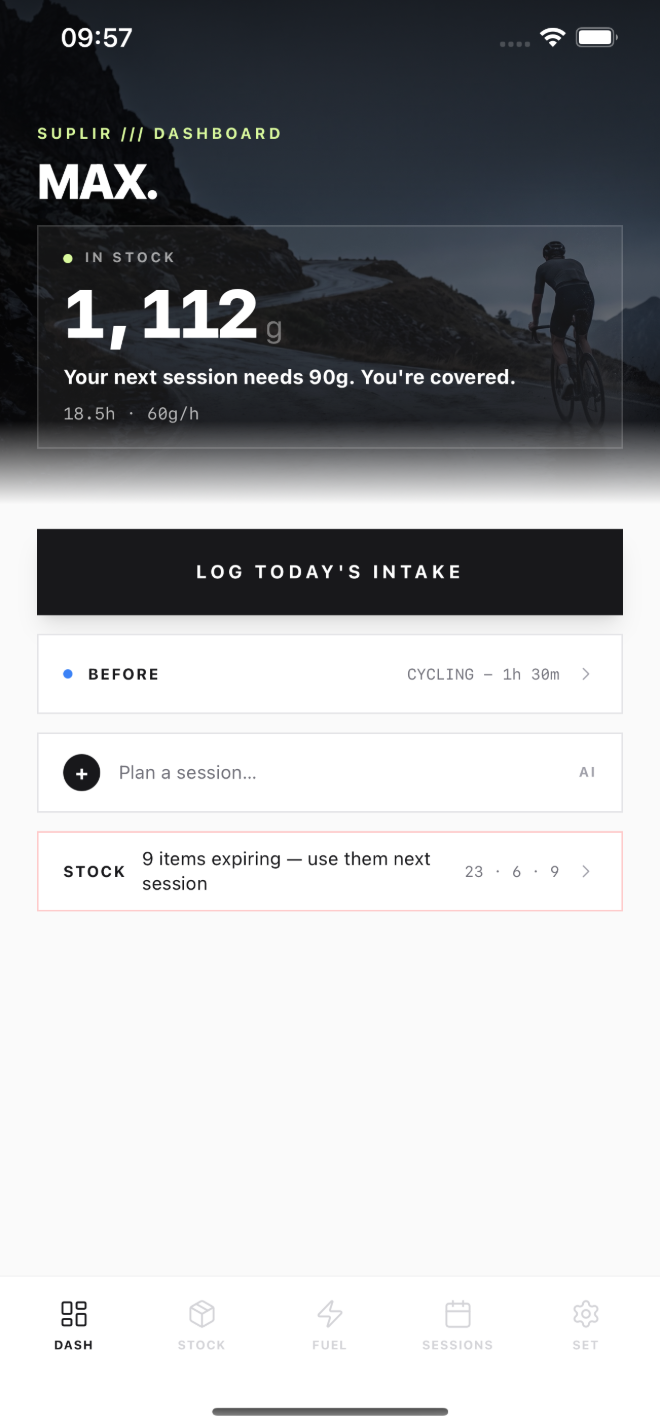
Import your .zwo or .fit file directly into SUPLiR. The app reads the intensity structure and calculates – based on your FTP and body weight – exactly how many carbohydrates you need at each point in the session. The result: a minute-by-minute plan using the products already in your inventory.
This means a relaxed 90-minute endurance ride gets different fueling to a 60-minute session with 3×10-minute threshold blocks – even though both are the same duration. The watts decide, not the clock.
Download a training plan
Grab a structured plan – for example the free OUTLYR Turbo Season (English version available) or any plan of your choice from TrainingPeaks. You'll receive .zwo files for each session.
Import the .zwo file into SUPLiR
Open SUPLiR, create a new activity, and import the .zwo file for your planned session. SUPLiR reads the intensity structure automatically.
Get your fueling plan
SUPLiR calculates your personal carbohydrate needs based on your FTP, body weight, and the session's intensity structure – then shows you which products from your inventory to use and when.
Set up your products and start
Place your gels, bars, or drinks next to the trainer – and ride the session knowing your energy will hold up through every interval block.
One thing frequently overlooked during indoor sessions: fluid needs. Without airflow and in a warm room, sweat loss on a smart trainer can reach 1–1.5 litres per hour – noticeably more than comparable outdoor effort.[1] A fan isn't a luxury, it's essential – it measurably reduces sweat rate and keeps core temperature more stable.
A good rule of thumb: at least 500–750 ml per hour, more during intense sessions or in warm rooms. Electrolytes are often overlooked – for sessions over 60 minutes, a sports drink beats plain water.
Put your bottle somewhere you can reach it without thinking – not tucked behind the trainer. If getting to it takes effort, you'll drink too rarely.
Winter on the trainer isn't a bridge to the real season – it is the real foundation. Riders who use this time not just to train, but to practise fueling, simultaneously build gut tolerance for higher carbohydrate intake.[2] A trained gut can absorb significantly more during a gran fondo or sportive in summer – and that's a measurable performance advantage.
Use the indoor season to gradually increase your personal carbohydrate limit. Start conservatively, observe how your gut responds, and nudge the target upward session by session. By the time the outdoor season starts, you'll be not just fitter – but better fuelled.
Import your .zwo file into SUPLiR and get the right fueling plan automatically – based on your FTP, your body weight, and the products already in your inventory.
Download SUPLiR