

The bib number is ordered, training is on track, form is good. But between you and a strong finish at Mallorca 312, L'Étape du Tour, or Nove Colli stands one question: What do I eat, and when? This guide answers it – from 72 hours before the start to 48 hours after crossing the finish line. Because nutrition isn't a detail. It's often the difference between triumph and bonking.
A gran fondo isn't a regular training ride. The intensity is higher, the duration longer, the mental pressure greater. Your body burns carbohydrates faster than you're used to – and when the stores are empty, the race is over. Not because your legs fail, but because your brain pulls the emergency brake.
The bonk – the dreaded "hitting the wall" – isn't weakness. It's biochemistry. When glycogen stores in muscles and liver are depleted, the body switches to energy-saving mode. Performance collapses, not because you don't want to continue, but because you physiologically can't.[1]
The good news: With the right strategy, bonking is completely avoidable. But the strategy doesn't begin on race morning. It begins 72 hours earlier.
These events attract thousands of amateur racers every year. The distances vary significantly – and so does the nutrition strategy. A 120km event like the Maratona dles Dolomites needs a different approach than the 312km Mallorca challenge.
Regardless of the event: The nutrition principles remain the same. Only the amounts and timing vary.
Carb loading isn't a nutrition myth from the '70s. It's a scientifically proven method to fill glycogen stores beyond normal levels. Done correctly, you can increase your carbohydrate reserves by 50-100%.[2] That means: You start with full tanks, not half-full ones.
The principle is simple: When you reduce training volume while increasing carbohydrate intake, the body stores more glycogen than normal. But timing and execution are crucial. Started too early, it doesn't work; started too late, you feel bloated at the start.
Target: 6-7 g carbohydrates per kg body weight. This is still in the normal range for an endurance athlete. You train normally but not intensely. No hard intervals, no long base rides. Example at 75 kg: 450-525 g carbs. Distributed across 5-6 meals, that's about 80-100 g per meal – manageable without stuffing yourself.
Target: 8-9 g/kg. Now it gets serious. Training volume drops to a maximum of 60 minutes easy spinning. Your body gets the signal: Carbohydrates in abundance, low expenditure – time to store. Slowly reduce fiber to avoid digestive issues. Example: 600-675 g carbs. That's about 120-135 g per meal at 5 meals. Here you'll notice you're eating more than usual.
Target: 10-12 g/kg. The peak of carb loading. Only 30 minutes of very easy spinning, no more. Eating now becomes the main task. White rice, light pasta, white bread – fiber is completely avoided. Keep fat low so there's room for carbohydrates. Example: 750-900 g carbs. This sounds like a lot because it is a lot. Spread throughout the day it's doable. Important: Still drink enough – glycogen is stored with water.
Glycogen isn't simply "deposited" in muscles. Each gram of glycogen binds about 3 grams of water.[2] This explains the slight feeling of fullness and the 1-2 kg weight gain during carb loading – this is mostly water, not fat. On race day, this water is worth its weight in gold because it simultaneously serves as a fluid reserve. Studies show that properly executed carb loading can extend time to exhaustion at constant load by 20-30%.[3]
On Saturday before the race, doing one more "proper training session" to burn off nervousness. This destroys the carb loading effect. The muscles burn exactly the glycogen you're trying to build up. Maximum 30 minutes very easy – nothing more.
The new Carb Loading Gateway activates automatically 72 hours before your event. It shows you day by day, based on your body weight, exactly how many grams of carbohydrates you should eat – No calculating, no guessing. Just a clear plan.
Race morning is no time for experiments. Everything you eat should have been tested multiple times in training. The basic rule: 2-3 hours before the start, a carbohydrate-rich, low-fat and low-fiber meal.
Target: 2-3 g carbohydrates per kg body weight. At 75 kg, that's 150-225 g. Practically: A large portion of oatmeal with banana and honey, plus toast with jam. Or rice with some sugar and cinnamon. Sounds unusual but works excellently.
Caffeine is optional, but if you use it, now is the time. An espresso 60-90 minutes before the start gives you mental focus without causing stomach problems. Important: Don't overdo it. 3-6 mg caffeine per kg body weight is the scientifically recommended dose for performance enhancement.[4] At 75 kg, that's 225-450 mg – equivalent to 2-4 espressos.
The most common mistake at the first gran fondo: Eating too much too soon. The excitement at the start, the high pace in the first kilometers, the battle for position in the group – all this sends stress signals to your body. Blood is redirected from digestive organs to muscles. Anyone fueling aggressively now risks nausea and stomach cramps.
In the first 30-40 minutes, your glycogen stores are still practically full. You don't yet need external energy supply. This is especially true if you've executed carb loading properly.
First carbohydrate intake after 30-40 minutes at moderate intensity. At very high start intensity (group battle, steep climbs), wait until 50-60 minutes. Begin with small amounts: 20-30 g, not a complete gel all at once.
This is where the race is decided. Not by wattage or tactics, but by nutrition. Your goal: 60-90 g carbohydrates per hour, depending on intensity, body weight, and individual tolerance.
Why this range? At moderate pace (like many gran fondos in a group), 60-70 g/h is completely sufficient. Your oxidation rate – the speed at which your body burns carbohydrates – is lower at 70-75% of maximum heart rate than at full throttle. Eating more provides no additional benefit but increases the risk of stomach problems.
At higher intensity – when you're at the front, attacking climbs, or riding solo – the need rises to 70-90 g/h. Here the glucose:fructose mix is crucial. Pure glucose can be absorbed at a maximum of 60 g/h (SGLT1 transporter limit). For higher amounts, you additionally need fructose, which is absorbed via a different transporter (GLUT5).[5]
Your gut has two different transport pathways for sugar. SGLT1 transports glucose (and galactose), GLUT5 transports fructose. Each pathway can process about 60 g/h. If you only eat glucose, you're stuck at 60 g/h – no matter how much more you try to consume, it won't be absorbed faster. With a 2:1 or 1:0.8 glucose:fructose mix, you use both pathways and reach 90-120 g/h. That's the difference between "just managing" and "feeling strong".[5]
Practically: Alternate between different products. 2-3 gels per hour, plus isotonic drink at feed stations. Check ingredient lists: Most modern gels already have a glucose:fructose mix. If it only says "maltodextrin," it's pure glucose – then you need something additional with fructose.
In long events like Nove Colli (205 km) or Mallorca 312, nutrition becomes the limiting factor. Not because you run out of carbohydrates, but because your stomach eventually rebels. Flavor fatigue sets in. The seventh gel doesn't taste good anymore, the eighth barely goes down.
The solution: Variation. From hour 5 or kilometer 120 (whichever comes first), incorporate solid food. A banana, an energy bar, rice cakes, even a piece of white bread with honey. This gives your stomach a break from gel monotony and works psychological wonders.
Important: Carbohydrate intake remains constant. Even if you're now eating more slowly, you must maintain the 60-90 g/h. A banana has about 25 g carbs, a bar 30-40 g. Calculate and compensate with gels or drinks.
At Mallorca 312 or other extreme events: From hour 5, consciously plan "real food." Pack a small zip bag with rice bites (with some salt), mini-bananas, or energy balls. These small moments – "Ah, something other than gel" – can be mentally decisive.
Feed stations at gran fondos are fantastic – but they're not a replacement for your own strategy. They're a backup, a supplement, a safety net. But not the main source.
The problem: You don't know exactly what will be at the station, in what quantity, and whether it's compatible with you. Is the cola with or without carbonation? Are the bananas ripe or green? Are there isotonic drinks or just water?
The pros do it this way: Carry your own products, use stations for water and as backup. If you notice at kilometer 80 that you packed too little – now the stations kick in. But never plan your nutrition exclusively around stations.
Recovery doesn't begin the day after the race. It begins in the first 30 minutes after crossing the finish line. In this window, your body is maximally receptive to nutrients. Enzymes for glycogen synthesis are upregulated, muscles are well-perfused, absorption capacity is higher than at any other time.[6]
Target: 1-1.2 g carbohydrates per kg body weight plus 20-30 g protein. At 75 kg, that means: 75-90 g carbs and about 25 g protein. Practically: A recovery shake is ideal here. Quickly available, easily digestible, precisely dosed. Alternatively: 2-3 bananas plus a protein bar. Or chocolate milk (a classic among cycling pros – actually works very well).
Why protein? After long exertion, muscle proteins are damaged. Protein – specifically essential amino acids – starts the repair. Without protein, you recover more slowly, even if glycogen stores are full.[6]
Now it's about completely refilling glycogen stores and supporting muscle regeneration. Target over 24 hours: 8-10 g carbohydrates per kg body weight. At 75 kg, that's 600-750 g, distributed across 5-6 meals.
This sounds like a lot, but after a 5-6 hour race, you're hungrier than you thought. Large carbohydrate portions every 2-3 hours. Pasta, rice, potatoes, bread. Plus 20-30 g protein each: Chicken, fish, eggs, legumes. Vegetables for micronutrients, but not so much that it displaces the carbohydrates.
Important: Even if you're tired, don't fall back on "junk food." Fries and pizza have lots of fat, which slows glycogen synthesis. You recover faster with clean carbs.
After 24 hours, glycogen stores are mostly refilled. Now it's about long-term regeneration. Reduction to 6-8 g/kg. More vegetables, healthy fats, high-quality protein. The body has recovered, now it's not about rapid restoration but adaptation and supercompensation.
Sleep becomes as important as nutrition now. 8-9 hours per night if possible. While you sleep, repair processes run at full speed.
The Recovery Gateway remains active for 48 hours after your event. It shows you exactly which recovery phase you're in, what you should eat now, and when the next meal is due. No more guessing – just a clear path back to full performance.
Let's make this concrete. Here's a complete plan for Mallorca 312, one of Europe's most challenging gran fondos. Profile: Mostly rolling, several significant climbs, mixed terrain, average speed around 25 km/h.
05:00 (3h before start):
Oatmeal (80 g) with banana, honey, and some milk = ~150 g carbs
2 slices toast with jam = ~50 g carbs
500 ml water
Total: ~200 g carbohydrates
06:30 (1.5h before start):
1 gel (25 g carbs)
300 ml water
07:30 (30 min before start):
1 espresso (optional, if tolerated)
Small bottle of water
Total during race: ~850 g carbohydrates over 12 hours = 70 g/h (perfect for ultra-endurance pace)
20:00-20:30 (0-30 min):
Recovery shake: 80 g carbs + 25 g protein (immediately after finish)
1 banana (additional 25 g carbs)
22:00 (2h after finish):
Large meal: Pasta with tomato sauce and chicken. ~150 g carbs, 40 g protein.
Next morning (Day +1):
Continue 6-8 g/kg carbohydrates. Normal large meals. Lots of sleep.
Many wait until they feel hungry. Then it's too late. Hunger is a delayed signal – when it comes, stores are already critically low. Start after 30-40 minutes, even if you're not hungry yet.
Gulping down a whole gel in 10 seconds overwhelms the stomach. Better: Consume gel over 2-3 minutes, with water in sips. Gives the digestive system time.
At events over 4 hours, this becomes monotonous. Vary: Gels, bars, bananas, isotonic drinks. Keeps the stomach happy and the psyche motivated.
Trying a new gel because it looks good at the feed station? Bad idea. Test EVERYTHING beforehand in training. Your stomach is not a test lab, not on race day.
After the finish, first shower, then leisurely eat something. You're wasting the golden 30-minute window. Pack a recovery shake in your transition bag – drink it immediately after finishing.
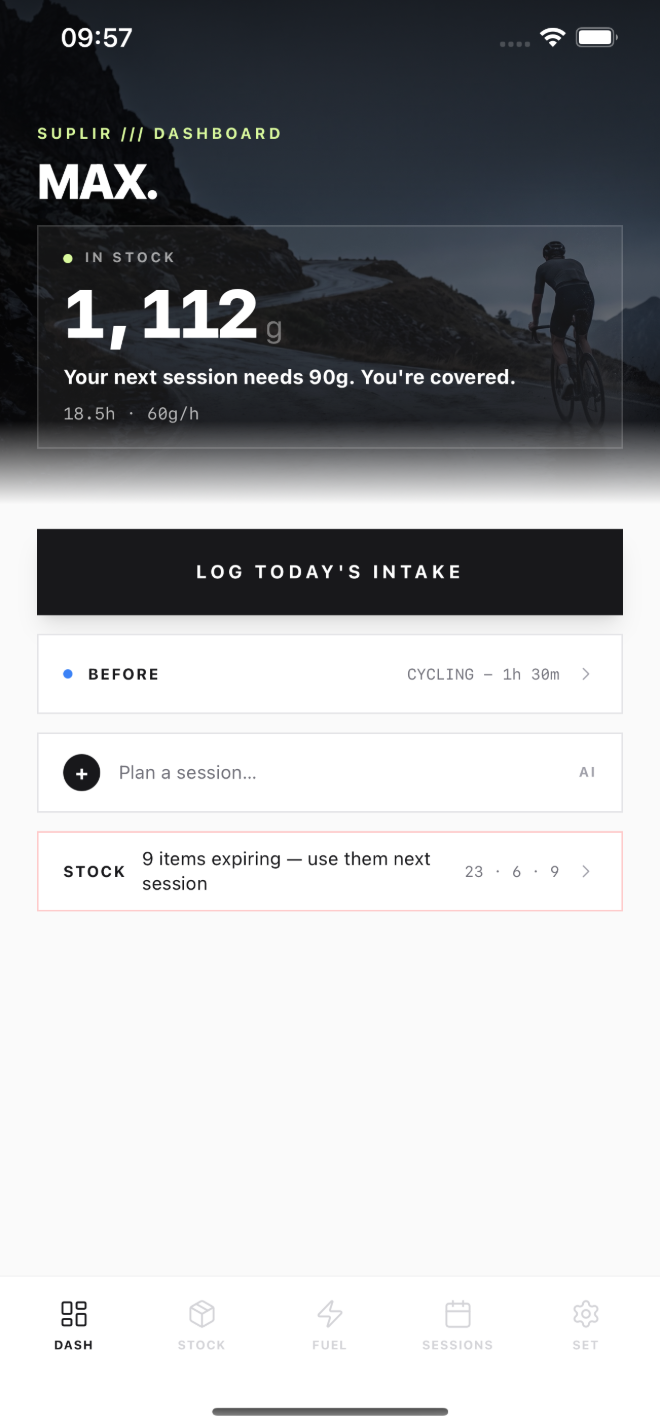
SUPLiR creates a complete nutrition plan for you – from carb loading to recovery – based on your route, body weight, and products. Carb Loading Gateway reminds you 72h beforehand. Recovery Gateway tracks your 48h afterwards.
Try SUPLiR for free